The Accountability Gap: Why PMs Struggle to Own AI Outcomes
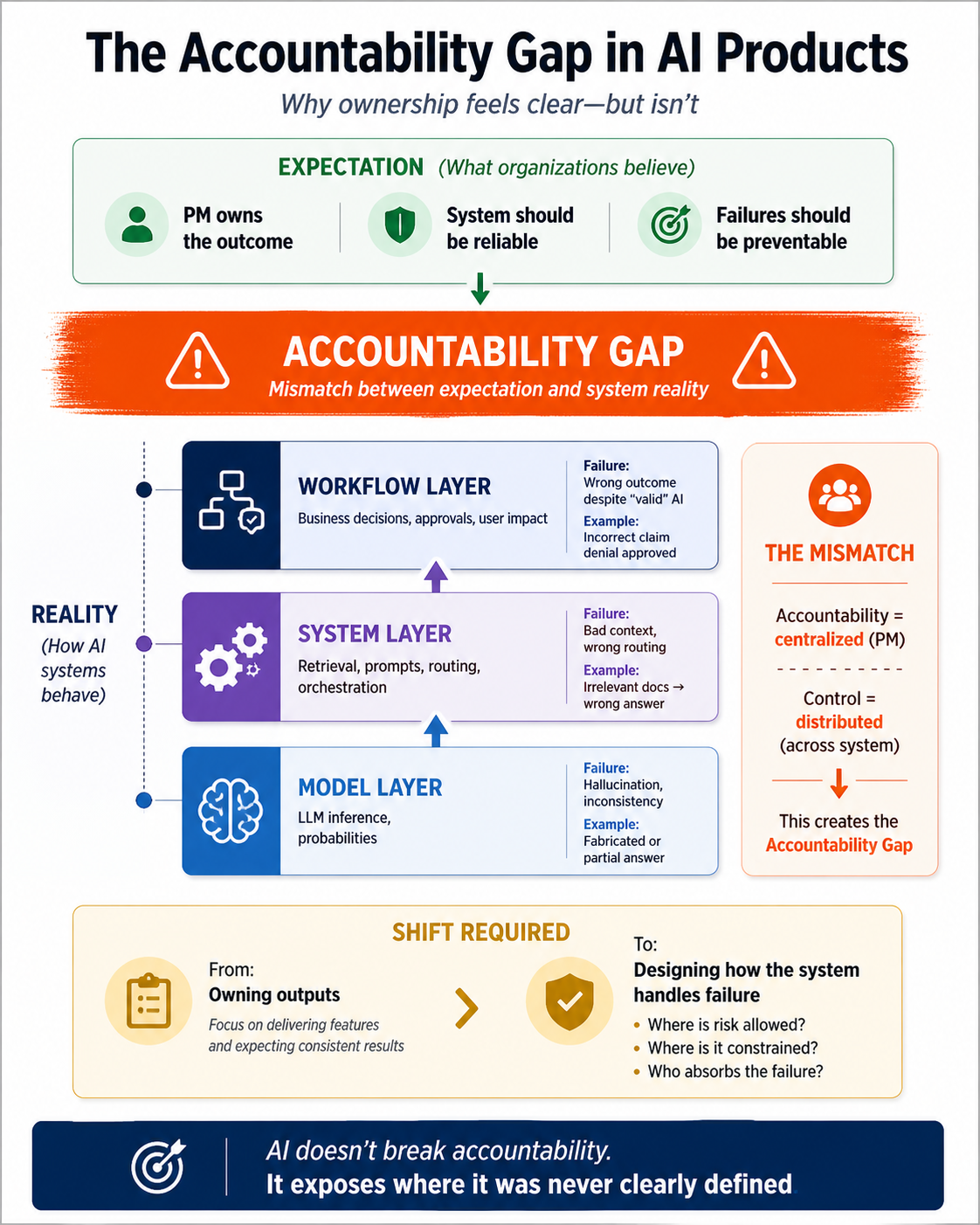
The Accountability Gap: Why PMs Struggle to Own AI Outcomes
Why the Shift from Deterministic Code to Probabilistic Systems Breaks Traditional Product Ownership
Executive Summary
Every enterprise AI organization eventually encounters the exact same crisis.
A machine learning model produces a flawed recommendation. An automated agent triggers an unintended transaction. An enterprise customer experiences an uncalibrated refusal. When executive leadership convenes the retrospective and asks: "Who owns this decision?" the room goes silent.
In deterministic software, accountability was straightforward. Code was an explicit transcription of business logic. If a feature malfunctioned, the failure was traceable to a missing requirement, an unhandled edge case, or an engineering regression. Ownership was bounded by control.
AI systems break this equation. When outputs are probabilistic, product managers are held accountable for system outcomes they cannot mechanically control. This structural mismatch is The Accountability Gap.
Closing this gap requires redefining product ownership: shifting focus from output delivery to containment architecture.
Why Does Traditional Product Ownership Collapse with AI?
For thirty years, product management operated on a foundational premise: clear specifications produce predictable execution.
| Software Dimension | Traditional Software Ownership | AI-Native System Ownership |
|---|---|---|
| System Behavior | Deterministic: Identical inputs yield identical outputs. | Probabilistic: Outputs degrade along a confidence distribution. |
| Acceptance Criteria | Binary verification (Pass / Fail test suites). | Statistical evaluation (AUC, calibration, drift tolerances). |
| Root Cause Analysis | Linear bug tracing down to lines of application code. | Multi-layer attribution (Data freshness, prompt drift, model bias). |
| Primary PM Lever | Feature specifications and UI flow optimization. | Boundary enforcement, friction vectors, and circuit breakers. |
| Definition of Failure | An unhandled exception or broken user journey. | Silent semantic drift and confidently wrong hallucinations. |
When a traditional system failed, something in the code was broken, and therefore fixable.
When an AI system fails, the code often executed exactly as designed. The retrieval database returned top-$k$ matches, the prompt template formatted correctly, the model returned a valid completion within token limits, and the UI displayed the result without error. Yet the business decision was systematically invalid.
Blaming "the AI" is an evasion. Blaming the engineering team for probabilistic variance is a misunderstanding. The accountability belongs at the product layer, because the product layer defined the risk envelope, the automation thresholds, and the escalation boundaries.
The PM's Retrospective Blame-Buster: The Incident Attribution Matrix
When an AI system makes a mistake and executive leadership asks "Who owns this failure?", retrospectives routinely devolve into cross-team finger pointing. Use this attribution matrix to pinpoint root cause and assign permanent architectural ownership:
| Where the Failure Occurred | Who Owns the Fix | The Typical Excuse in the Retrospective | What the PM Enforces as the Permanent Invariant |
|---|---|---|---|
| Data Ingestion | Data / Platform Eng | "The user uploaded an outdated policy scan with rotated margins." | Add document freshness metadata and reject unparseable attachments at the front door. |
| Context Retrieval | Search / ML Eng | "The vector database retrieved semantically adjacent text from an old handbook." | Implement hybrid keyword-vector filtering and hard tenant-isolated metadata tags. |
| Model Hallucination | AI / Prompt Eng | "The model got creative and hallucinated a clause despite prompt instructions." | Strip open text synthesis. Force strict JSON schema output with explicit refusal examples. |
| Business Execution | Product Manager | "The model reported 95% confidence, so our service auto-committed the action." | Product Ownership: Autonomy was too high. Wrap execution in hard dollar caps and mandatory human sign-off. |
The Anatomy of the Accountability Gap
The accountability gap manifests across three compounding operational dimensions:
| Progression Stage | Operational Dynamic | Enterprise Impact |
|---|---|---|
| 1. Probabilistic Variance | Identical inputs produce divergent completions without underlying code changes. | The product team cannot guarantee deterministic repeatability on demand. |
| 2. Diffuse Attribution | Failures traverse multiple layers (stale data, vector misses, model drift, loose thresholds). | Organizational gridlock; engineering, data, and product blame each other. |
| 3. Executive Retraction | Unbounded risk forces leadership and risk committees to intervene. | Autonomy is revoked; systems are throttled back to slow manual queues. |
1. The Variance Penalty
In traditional products, PMs guarantee functional outcomes. In AI products, the same prompt with identical parameters can yield divergent outputs across model minor versions, temperature samplings, or changing vector context. PMs are forced to defend outcomes they cannot deterministically reproduce on demand.
2. The Attribution Void
When a multi-stage retrieval or agentic workflow fails, attribution dissolves across four distinct interfaces: - Ingestion Failures: Did the upstream data pipeline ingest stale, unindexed, or corrupted unstructured documents? - Retrieval Failures: Did the vector database select semantically adjacent but legally irrelevant context chunks? - Inference Failures: Did the foundation model reason incorrectly or hallucinate despite receiving valid context? - Threshold Failures: Did the product team authorize an overly aggressive confidence threshold to artificially boost automation metrics?
Without formal component contracts, each team points downstream, producing organizational gridlock.
3. The Human-in-the-Loop Illusion
To manage liability, organizations reflexively insert human review steps. But uncontracted human oversight creates a dangerous moral hazard. Reviewers overwhelmed by high transaction volumes default to rubber-stamping AI recommendations. When a failure occurs, management blames the human reviewer for missing the error, while the reviewer blames the model for proposing it.
The Four Pillars of AI Product Accountability
To close the accountability gap, product leaders must replace vague aspirations of "accuracy" with four architectural disciplines:
1. Defining the Invariant Error Budget
Product managers must define acceptable failure bounds before deployment. If an automated customer support system has a 2% allowable hallucination threshold on policy questions, that threshold must be tied directly to a business balance sheet:
$$\text{Error Budget} = \text{Authorized Transaction Volume} \times \text{Expected Error Rate} \times \text{Remediation Cost}$$
When telemetry indicates that error rates exceed the budget, system autonomy is automatically downgraded by deterministic circuit breakers rather than post-hoc committee debate.
2. Engineering Asymmetric Escalation Boundaries
A low-risk recommendation (such as suggesting an email subject line) requires near-zero friction. A high-stakes transaction (such as denying a commercial loan or transferring capital) requires asymmetric defense. PMs must map every automated action into explicit operational control tiers, as detailed in Control Tiers for AI Systems.
3. Causal Decision Tracing
PMs cannot own what they cannot reconstruct. For every consequential AI decision, the system must log an immutable execution trace capturing: - The active risk threshold and policy-as-code version. - The retrieved knowledge chunks and cosine similarity scores. - The model checkpoint hash, prompt template digest, and raw completion. - The operator interaction telemetry (time-on-screen, override reason codes, and digital signature).
This ensures postmortems are forensic findings rather than speculative arguments.
4. Minimizing the Cognitive Re-entry Tax
When an AI system escalates an ambiguous case to a human expert, the product must minimize Time-to-Context (TTC). Dumping raw JSON logs onto an operator creates fatigue and guarantees errors. Strong product design provides the causal delta, highlighting precisely why the model's confidence degraded and what specific decision requires human judgment.
The Adversarial Stress-Test: Five Critical Inquiries
1. What is the strongest argument against this approach?
Requiring PMs to define invariant error budgets, mathematical friction vectors, and component contracts slows down experimentation. In fast-moving commercial markets, teams that ship unconstrained LLM wrappers will capture user mindshare and distribution before heavily governed architectures complete their initial risk review.
The Practical Resolution: Establish a tiered development pipeline. High-velocity exploratory prototypes deploy within Tier 1 sandboxes with zero state-mutation authority, allowing rapid iteration without governance overhead. Impose formal error budgets and component contracts only when promoting a feature to Tier 2 autonomous execution.
2. Under what circumstances would this fail?
This framework fails during systemic distribution shifts or subtle prompt injection attacks. If an adversary tricks the model using linguistic obfuscation that satisfies all semantic schema checks, the system executes a commercially catastrophic action that passes every local invariant without tripping confidence alerts.
The Practical Resolution: Couple probabilistic semantic guards with deterministic, out-of-band policy blockers. Regardless of model confidence scores, business transactions exceeding monetary caps or altering core authorization state must pass hardcoded deterministic rules that an LLM prompt cannot bypass.
3. What would a skeptical customer, client, or colleague object to?
A skeptical enterprise customer or procurement officer will object that admitting software is probabilistic and requires error budgets is merely an excuse for vendors to dodge standard software performance warranties.
The Practical Resolution: Transform probabilistic transparency into a commercial differentiator. Provide customers with contractual service-level agreements backed by programmatic circuit breakers, verifiable decision traces, and automated financial indemnification for any errors that exceed contracted bounds.
4. Which alternative deserves more consideration?
Algorithmic Liability Insurance & Automated Reconciliation. Instead of designing complex inline escalation architectures, allow models to operate with minimal friction and purchase third-party algorithmic liability insurance. Use automated reconciliation bots to issue refunds or corrections after errors occur, treating AI failures as a standard cost of doing business.
The Practical Resolution: Adopt reconciliation bots and insurance pools for reversible low-dollar e-commerce transactions. For regulated banking, healthcare, or employment decisions, statutory non-discrimination and procedural due process mandates render post-hoc financial remediation legally insufficient.
5. What am I assuming that may not be true?
This framework assumes that model confidence scores and logit distributions are reliable indicators of factual truth, whereas empirical research demonstrates that frontier models can exhibit extreme overconfidence on novel out-of-distribution inputs.
The Practical Resolution: Do not rely on model self-reported confidence alone. Triangulate confidence using ensemble consensus, semantic entropy across multiple samplings, and deterministic feature validation at the ingress gateway.
One-Line Synthesis
AI product accountability requires designing the operational perimeters, circuit breakers, and decision traces that ensure failures are contained, attributable, and economically bounded.
Related Reading in the Accountability Suite
-
Who's Accountable When the AI Gets It Wrong?: The flagship monograph detailing the four-layer accountability stack, contract lifecycles, and verification loops.
-
The New Product Sense: Knowing When AI Should Stop: Designing asymmetric escalation boundaries and dynamic friction vectors.
-
Why AI Product Sense Requires Systems Judgment: Navigating the collapse between product strategy and system architecture.
-
How to Write AI Component Contracts: Practical guide for specifying behavioral bounds and input invariants in production AI systems.
-
Control Tiers for AI Systems: Structuring autonomy levels, evidence gates, and automated circuit breakers.
Subscribe to the Architecture of Proof Dispatch
Rigorous, decision-forcing systems engineering and AI governance monographs for technical leaders. Delivered periodically, zero spam.