State Is the Moat in the AI World
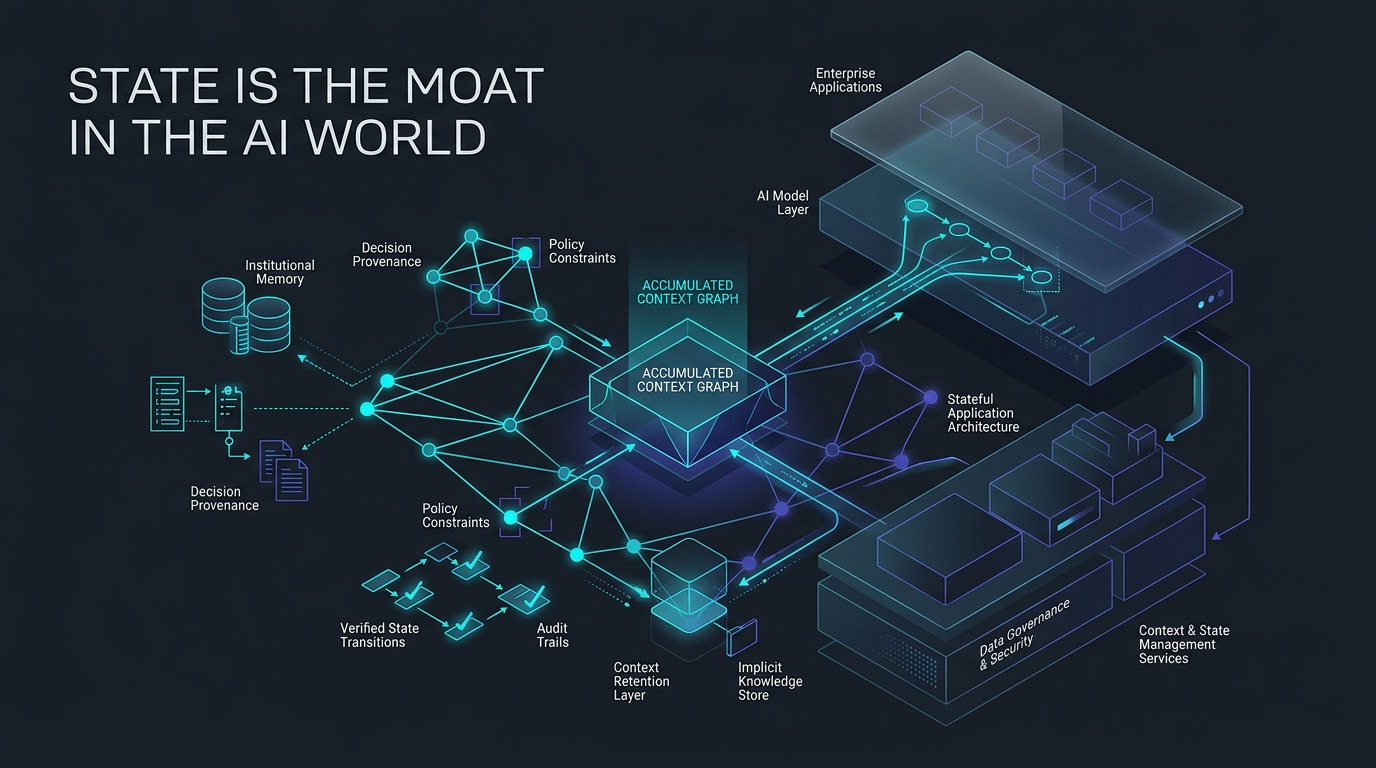
Why Is Proprietary Data an Incomplete Enterprise Moat?
As foundational reasoning models become interchangeable commodities, product leaders reach for a standard defense: "If intelligence is commoditized, then proprietary enterprise data is our moat."
In enterprise AI systems, that reflex is dangerously incomplete.
Dumping ten years of raw chat logs into a vector database creates noise rather than leverage. Storing every inference output in a relational database records execution history without establishing validity. Even possessing massive proprietary enterprise data fails to generate defensibility when the underlying assertions lack verification.
A durable enterprise moat requires accumulated, verified state that remains admissible for future action.
The distinction determines whether organizational history can answer the questions that matter when an autonomous agent is about to execute a consequential action:
| Audit Dimension | Core Forensic Question | Operational Requirement |
|---|---|---|
| Committed Action | What exact mutation occurred? | Concrete state transition committed to production, beyond raw model generation. |
| Normative Rationale | Why did the system permit it? | Explicit rule, policy condition, or statutory exception active at runtime. |
| Institutional Authority | Who sanctioned the decision? | Named human supervisor, explicit organizational role, and delegated signing limits. |
| Precedent Scope | What exception was applied? | Documented variance with verified validity boundaries and expiry triggers. |
| Empirical Verification | What followed the action? | Subsequent business outcome confirming or undermining the original judgment. |
| Current Admissibility | Is the precedent still valid today? | Active verification that authority, counterparty status, and policy remain unexpired. |
A vector database of unverified outputs cannot answer these questions. An Accumulated Context Graph, designed with explicit provenance controls, can.
How Does an Accumulated Context Graph Differ From Ordinary Agent Memory?
The term "memory" in AI systems is widely used to describe anything from short-term retrieval buffers to long-term vector stores. An Accumulated Context Graph is something more specific.
Formal definition: An Accumulated Context Graph is a permissioned, temporal representation of organizational entities, decisions, actions, exceptions, evidence, and outcomes, connected by provenance and updated through verified state transitions.
Note on Terminology: In this architecture, "Graph" describes the relational, temporal, and provenance topology of organizational state, not a mandate for a specific database engine. An ACG can be implemented using relational tables with foreign-key provenance, event-sourced ledgers, graph databases, or a hybrid storage model.
An Accumulated Context Graph is distinguished from ordinary agent memory by its governance and admissibility layer rather than raw data volume.
| Dimension | Ordinary Agent Memory | Accumulated Context Graph |
|---|---|---|
| Stores | Information for future retrieval | State and relationships across time |
| Preserves | Text or summaries | Entities, events, authority, and outcomes |
| Optimized for | Relevance | Relevance, validity, provenance, and admissibility |
| Verification | Often contains unverified assertions | Separates observations, inferences, approvals, and verified precedents |
| Primary function | Retrieves context | Supports governed decisions and state transitions |
This distinction matters operationally. A retrieval system that surfaces a stale exception as current policy is worse than no system at all. The ACG primarily guarantees admissibility rather than raw recall.
What Is the Three-Layer Architecture of an Accumulated Context Graph?
An ACG organizes persistent organizational state across three layers. Ephemeral inference context (the immediate token window, working scratchpads, and tool execution returns) serves as the input mechanism to this system, not part of the accumulated state itself.
flowchart TD
    subgraph INPUT["Ephemeral Input Layer (Not Defensible)"]
        A["Immediate Inference Context<br/><small>Token Window • Working Scratchpads • Tool Returns</small>"]
    end

    subgraph ACG["ACCUMULATED CONTEXT GRAPH (Persistent State)"]
        direction TB
        B["Layer 1: Episodic Execution & Provenance Events<br/><small>Append-only ledger of proposals, tool calls & outcomes (Traceability)</small>"]
        C["Layer 2: Semantic Graph of Institutional Entities<br/><small>Organizational relationships, policies, roles & exception precedents</small>"]
        D["Layer 3: Governed Decisions & Verified Precedents<br/><small>Authorized overrides, scoped rules, validity intervals (Compounding Moat)</small>"]

        B --> C
        C --> D
        D -. "Feedback & Validity Revalidation" .-> C
    end

    A --> B

    style INPUT fill:#18181b,stroke:#52525b,stroke-width:1.5px,stroke-dasharray:4 4,color:#e4e4e7
    style ACG fill:#09090b,stroke:#10b981,stroke-width:2px,color:#ffffff
    style A fill:#27272a,stroke:#71717a,stroke-width:1px,color:#f4f4f5
    style B fill:#18181b,stroke:#3b82f6,stroke-width:1.5px,color:#ffffff
    style C fill:#18181b,stroke:#8b5cf6,stroke-width:1.5px,color:#ffffff
    style D fill:#064e3b,stroke:#10b981,stroke-width:2px,color:#ffffff
Layer 1: Episodic Execution and Provenance Events (Traceability)
An append-only record of proposals, tool calls, approvals, rejections, mutations, evidence, and outcomes. This layer records what happened. It does not automatically establish what is true. A raw model output preserved here has traceability value, but it does not carry the same semantic status as a human-authorized precedent. The distinction between observed event and verified state is load-bearing.
Layer 2: Semantic Graph of Institutional Entities (Structural Context)
The topology representing how the enterprise actually operates: the relationships between clients, account classifications, unwritten exception policies, regulatory boundaries, and department-level hierarchies. Not the org chart the company published. The actual decision graph embedded in operating practice.
Layer 3: Governed Decisions and Verified Precedents (The Compounding Moat)
The structured repository of authorized decisions, policy interpretations, escalation resolutions, outcome confirmations, and human overrides: each annotated with why the decision was made, who had authority to make it, what conditions applied, and when it remains valid.
A foundational model knows how an idealized workflow operates. An Accumulated Context Graph knows how this specific organization operates: including every exception, precedent, and edge-case judgment made by real humans under real conditions, and whether those judgments are still admissible today.
Why Does Institutional State Have a Half-Life?
Institutional state is not permanently true merely because it was once verified. Policies expire. Authorities change. Exceptions close. Relationships decay. A regulation gets amended. A customer relationship restructures. An employee's scope of authority narrows.
The question is not only, "Was this decision verified?" It is also, "Is this decision still admissible now?"
An Accumulated Context Graph must therefore represent not just what was decided, but the validity conditions under which that decision can be reused. Each significant state node carries:
- Source: which agent, user, or system produced the event
- Timestamp: when the state was created or last confirmed
- Approver: who authorized it, and in what role at the time
- Evidence: what information supported the decision
- Validity interval: the conditions or time window under which the precedent applies
- Superseded-by: whether a newer decision has overridden this one
- Reuse conditions: the scope under which this precedent can propagate
A context graph that accumulates state without tracking validity is not a governance asset. It is a repository of stale exceptions waiting to propagate.
How Does an Accumulated Context Graph Operate in Commercial Underwriting?
To see how an Accumulated Context Graph operates in an enterprise workflow, consider a commercial credit underwriting platform processing a $10M working capital facility with non-standard collateral covenants.
Scenario A: The Ordinary Memory / Vector RAG Approach
- The loan underwriting agent ingests borrower financial statements, tax filings, and the bank’s credit policy documentation.
- Performing semantic similarity search across its vector store, the agent retrieves a historical loan memo from 18 months prior where a similar debt-service coverage ratio (DSCR) exception was granted to another borrower.
- The agent recommends loan approval, citing the retrieved memo as standard precedent.
- The Failure Mode: The retrieved text looked semantically relevant, but was institutionally inadmissible. That historical exception was a one-time emergency pandemic allowance authorized by an executive who has since departed, and the bank's Macro Risk Committee superseded that policy six months ago. The agent hallucinated compliance based on ungoverned memory.
Scenario B: The Accumulated Context Graph (ACG) Approach
- The agent evaluates the proposed exception against Layer 3 of the ACG (Governed Decisions & Verified Precedents).
- The system traverses the explicit state node: $$ \begin{aligned} \text{Borrower X} &\xrightarrow{\text{Exception}} \text{DSCR Waiver} \ &\xrightarrow{\text{Authorized by}} \text{Senior Credit Officer Y} \ &\xrightarrow{\text{Scope}} \text{Real Estate Collateral Only} \ &\xrightarrow{\text{Validity}} \text{Expired 2024-12-31} \ &\xrightarrow{\text{Status}} \text{Superseded by Policy Rev 4.2} \end{aligned} $$
- The agent identifies that while the precedent exists, its validity window has elapsed and the precedent was strictly scoped to real-estate-backed facilities.
- The Governed Action: Rather than generating an unauthorized approval, the agent surfaces the exact policy delta, compiles the evidentiary dossier, and routes an escalation to the current Credit Committee with full provenance.
- When the Committee issues a signed override with new terms, the Supervised Correction Loop parses the decision, updates the graph's validity conditions, and enriches institutional state for all future cycles.
Why Does State-Centric Strategy Outlast Model Churn?
| Dimension | Model-Centric Architecture | State-Centric Architecture |
|---|---|---|
| Core IP | System prompts, fine-tunes, retrieval configs | Relational entity graphs, audit trails, verified state transitions |
| Upstream upgrades | Disruptive: New model alters prompt behavior, renders fine-tunes obsolete | Accretive: Better models traverse existing context graphs with higher precision |
| Data gravity | Low; interaction data is largely ephemeral | High; every governed decision enriches the relational knowledge graph |
| Switching cost | Low; competitor can pass prompt to a newer LLM | High when state is deeply integrated into workflows, permissions, provenance, and decision history |
| Failure mode | Hallucinations on organization-specific edge cases | Stale exceptions or unclassified overrides propagating as global precedents |
The switching cost row requires precision. A competitor may be able to export entities, decisions, documents, and audit logs. The moat is that exporting the raw records does not reproduce the ingestion discipline, identity model, validation history, policy bindings, workflow integrations, and operational trust that make the graph useful.
Defensibility should not depend on captivity. A well-designed ACG offers portable data, documented schemas, and auditable transformations: switching costs are earned through operational embedding rather than enforced through lock-in.
How Does the Supervised Correction Loop Compound Value?
What makes the ACG compound in value is not passive storage. It is the Supervised Correction Loop: the mechanism by which authorized human interventions produce structural improvements to the graph.
The critical architectural constraint is that not every correction should enter shared state. An override may be idiosyncratic, politically motivated, inconsistent with policy, or valid only for a specific case. Without a classification gate, the graph compounds errors as easily as it compounds knowledge.
flowchart TD
    A["1. Agent Proposes Action / State Mutation"] --> B["2. Human Supervisor Reviews"]

    B --> C{"Decision"}
    C -- "Accepts" --> D["Execute & Record Provenance"]
    C -- "Adjusts / Overrides" --> E["3. Classification Gate"]

    E --> F["Case-Specific Adjustment<br/><small>Isolated one-off; no global propagation</small>"]
    E --> G["Reusable Precedent<br/><small>Contextualized exception rule with scope</small>"]
    E --> H["Policy Change<br/><small>Formal institutional rule update</small>"]
    E --> I["Data Correction<br/><small>Underlying entity attribute fix</small>"]
    E --> J["Adjudication Escalation<br/><small>Multi-stakeholder review required</small>"]

    G --> K["Store in ACG as Verified State<br/><small>Tagged with: Authority + Conditions + Validity Interval</small>"]
    H --> K
    I --> K

    K -. "Updated Graph Topology" .-> L["Next Agent Execution Cycle"]

    style A fill:#18181b,stroke:#64748b,stroke-width:1.5px,color:#ffffff
    style B fill:#18181b,stroke:#f59e0b,stroke-width:2px,color:#ffffff
    style C fill:#18181b,stroke:#3b82f6,stroke-width:1.5px,color:#ffffff
    style D fill:#18181b,stroke:#64748b,stroke-width:1px,color:#ffffff
    style E fill:#450a0a,stroke:#ef4444,stroke-width:2px,color:#ffffff
    style F fill:#18181b,stroke:#71717a,stroke-width:1px,color:#d4d4d8
    style G fill:#064e3b,stroke:#10b981,stroke-width:2px,color:#ffffff
    style H fill:#1e1b4b,stroke:#8b5cf6,stroke-width:1.5px,color:#ffffff
    style I fill:#172554,stroke:#3b82f6,stroke-width:1.5px,color:#ffffff
    style J fill:#451a03,stroke:#f97316,stroke-width:1.5px,color:#ffffff
    style K fill:#064e3b,stroke:#10b981,stroke-width:2px,color:#ffffff
    style L fill:#18181b,stroke:#10b981,stroke-width:1.5px,color:#ffffff
The graph should not learn from every correction. It should learn from corrections that have been classified, scoped, authorized, and validated.
One of the most valuable enterprise signals is an authorized expert's decision to override an agent, provided the product captures the reason, authority, applicable conditions, and eventual outcome. The correction becomes valuable after it is contextualized and classified.
How State Compounds: The Autonomy-Supervision Inversion
Compounding means the output of execution cycle $N$ directly increases the precision, speed, and autonomy of cycle $N+1$.
In an enterprise deployment, this produces a structural shift in human operational cost across three distinct maturity horizons:
| Maturity Horizon | Operational Supervisory Burden | Governing Mechanism | Institutional Asset Yield |
|---|---|---|---|
| Day 1: Cold Start | ~80% manual human review | Base models operate on generic public policies; edge cases require continuous manual escalation. | Baseline event capture in Layer 1 append-only ledger. |
| Day 30: Scoped Precedents | ~40% manual human review | Classification Gate extracts recurring exception patterns into bounded precedents with explicit TTLs. | Structured precedent topology populated in Layer 3. |
| Day 100: Autonomous Execution | ~5% exception escalation | Agents execute autonomously within verified precedent envelopes; supervisors review novel institutional anomalies. | Compounding state graph shielding the enterprise against model churn and competitive cloning. |
When intelligence becomes portable, institutional memory becomes the product.
What Is State Defending Against Across the Four-Front Moat?
Verified organizational state constructs an active defense across four distinct vectors:
1. Defense Against Foundation Model Encroachment (The Subsumed Pipeline Dilemma)
When frontier model providers release models with native multi-step reasoning, planning, and context reflection, bespoke procedural scaffolding (hand-crafted prompt chains, decomposition trees, and routing heuristics) is subsumed overnight. But for a state-centric architecture, a smarter upstream model is purely accretive. A more capable reasoning engine navigates entity relationships, provenance trails, and precedent constraints with higher fidelity and lower latency. The model provider owns the general reasoning engine; you own the enterprise ground truth.
2. Defense Against Fast-Follower Competitors (The Day 0 Deficit)
A competitor can clone your user interface in a weekend, inspect your API endpoints, and buy identical inference access from the same model provider. What they cannot clone is the density of verified organizational precedents.
When a competitor deploys their agent into an enterprise, their system starts at Day 0: with zero institutional memory, zero historical validation, and zero context on how internal policy tensions are resolved. Their agent will either hallucinate on company-specific edge cases or force the customer's staff to restart the 80% supervision cycle from scratch.
3. Defense Against Internal "DIY" Engineering (The Vector Store Fallacy)
Enterprise IT organizations frequently believe they can bypass third-party software by throwing documentation into an internal vector database (RAG).
Vector retrieval optimizes solely for semantic similarity while ignoring institutional admissibility:
- Who authorized this policy deviation?
- Has this client's special agreement expired?
- Does this junior engineer have the ambient authority to trigger this state mutation?
When internal DIY scripts cause unverified state mutations or compliance violations, the necessity of a governed, provenance-backed state graph becomes undeniable.
4. Defense Against Regulatory & Forensic Liability Traps
In governed industries (finance, healthcare, legal, critical infrastructure), autonomous agents without auditable state are uninsurable liabilities.
When an agent takes a consequential action, regulatory bodies and insurers demand proof: Why was this action taken, what evidence justified it, and what was the chain of authority? An Accumulated Context Graph provides deterministic forensic auditability, turning operational history into an admissible defense.
How Do Product Leaders Calculate the Defensibility Heuristic?
$$\text{Defensibility} \propto \frac{\text{Accumulated State} \times \text{Verification Density} \times \text{Workflow Dependence}}{\text{Model Portability}}$$
This is a strategic heuristic to evaluate asset durability across model cycles, not a measurable physics equation:
- Accumulated State: the volume of durable entities, events, decisions, exceptions, and outcomes the organization has produced through the system.
- Verification Density: the proportion of state linked to evidence, authority, and observed results; unverified accumulation reduces this factor.
- Workflow Dependence: how deeply critical operational work depends on the system's state and control plane.
- Model Portability: how easily the reasoning layer can be replaced without losing product value; designing for high portability is a proactive product strategy choice.
How Must AI Product Managers Shift Their PRDs for State-Centric Design?
Product managers transitioning from deterministic software to AI systems must move beyond writing feature specifications focused on prompts, output formats, and interface widgets. The architecture question and the product question have merged.
The Target Outcomes: What State Architecture Delivers
When an AI product transitions from a stateless inference pipeline to an Accumulated Context Graph, it achieves four deterministic outcomes:
- Upstream Model Invariance: Upstream frontier model upgrades become seamless configuration updates rather than disruptive prompt re-engineering crises.
- The Autonomy Inversion: Human supervisory intervention drops from 80% on Day 1 to 5% on Day 100 as verified institutional precedents compound.
- Institutional Memory Retention: Key personnel departures no longer trigger operational amnesia; authorized precedents, edge-case resolutions, and exception boundaries remain active in the graph.
- Deterministic Forensic Admissibility: Every autonomous agent action is anchored to an auditable proof trail, satisfying enterprise risk, compliance, and legal liability requirements.
The 5-Step Operational Playbook for AI PRDs
To build an architecture that compounds state rather than consuming ephemeral attention, AI PMs must mandate five concrete specifications in every PRD:
| Engineering Mandate | Core Operational Failure Mode | Required PRD Architecture Specification | State Graph Artifact Produced |
|---|---|---|---|
| 1. Capture Ephemeral Leakage | Expert human corrections vanish when session terminates. | Instrument all review interfaces to capture edit deltas, parameter overrides, and rejection rationales. | Immutable event node in Layer 1 ledger. |
| 2. Enforce Classification Gate | Unvetted overrides pollute shared organizational state with personal bias. | Require UI/control plane to classify overrides as case-specific, reusable precedent, policy update, or entity fix. | Scoped state mutation proposal with validation tags. |
| 3. Bind Cryptographic Authority | Execution history records actions without proving authorization. | Attach mandatory identity envelope: signer role, verification hashes, and source evidence links. | Provenance-bound node with non-repudiation envelope. |
| 4. Enforce Temporal Validity | Agents reuse expired emergency exceptions as permanent active policy. | Define explicit valid_until TTLs, review triggers, and superseded_by pointers checked prior to retrieval. |
Admissible precedent node with active lifecycle state. |
| 5. Decouple Domain Logic | Domain rules hardcoded in brittle 10,000-token system prompts. | Strip system prompts to minimal traversal harnesses; store organizational logic in structured graph. | Portable reasoning harness swappable across frontier models. |
The PRD Shift: Model-Centric vs. State-Centric Specifications
| PRD Section | Old Model-Centric Specification | New State-Centric Specification |
|---|---|---|
| User Override UX | "User can edit the agent output in a freeform text box." | "User override triggers Classification Gate to assign precedent scope, authority level, and applicability conditions." |
| Data Storage | "Save chat history in PostgreSQL; embed documents in Vector DB." | "Append execution events to Layer 1 ledger; update relational entity and precedent topologies in Layer 2/3." |
| Model Strategy | "Optimize system prompt for Model X's reasoning style." | "System prompt is a generic graph-traversal harness; underlying model is 100% swappable via API config." |
| Safety & Governance | "Apply generic keyword/toxicity guardrail filter." | "Run pre-execution admissibility check verifying precedent authority, temporal validity, and evidence linkage." |
The PM's State Defensibility Matrix: 5 Architecture Gates for Executive & PRD Reviews
To evaluate whether a proposed AI feature builds compounding product defensibility or merely wraps disposable inference, bring this matrix to architecture and executive reviews:
| Moat Dimension | Architectural Verification Check | Red Flag Condition (Commoditization Trap) | PM Mandate & Action |
|---|---|---|---|
| 1. Upstream Model Invariance | Can the underlying model be swapped to an alternative vendor without altering business logic? | Feature requires rewriting 10,000-token prompt chains whenever model providers update weights. | Decouple prompts into pure traversal harnesses; keep business rules in structured state. |
| 2. Ephemeral Override Capture | Do review interfaces capture human correction deltas, signed approvals, and rejection rationales? | Human supervisors correct agent outputs in external email or unlogged UI input fields. | Enforce mandatory override telemetry; log all deltas into Layer 1 execution ledger. |
| 3. Classification Gate Isolation | Are overrides classified by scope and authority tier before being persisted into shared state? | Human corrections are appended directly to few-shot prompts or vector indexes. | Block release. Route overrides through Classification Gate to prevent personal bias injection. |
| 4. Temporal Validity & Pruning | Does every precedent record explicit valid_until timestamps and policy revision pointers? |
Agents retrieve two-year-old emergency pandemic exceptions as active operating rules. | Mandate automated TTL validation queries before any precedent enters prompt context. |
| 5. Admissible Evidence Audit | Can an auditor trace any consequential action to a verified source document hash? | The agent generated an action based on retrieved text without recording document hashes. | Enforce non-repudiation envelope: bind actions to immutable evidence digests. |
The Adversarial Stress-Test: What Could Break an Accumulated Context Graph Moat?
To stress-test the strategic thesis that accumulated state serves as the definitive enterprise moat, we address five decision-forcing inquiries:
1. What is the strongest argument against this approach?
The Objection: As frontier models expand effective context windows to tens of millions of tokens with near-perfect needle retrieval and in-context reasoning, external structured state graphs risk becoming redundant overhead. If a model can ingest an enterprise's entire document corpus and transaction history dynamically on every call, the engineering investment in building and maintaining structured ACG schemas is subsumed by raw frontier compute.
The Practical Resolution: In-context retrieval across massive windows yields probabilistic associations rather than legally admissible, deterministic state mutations. Expanding context windows cannot solve non-repudiation, role-based authorization, or temporal policy expiry: an LLM reading an expired 2023 memo alongside current policy lacks the transactional guarantees required to invalidate the stale rule. The ACG separates ephemeral reasoning from durable institutional law, ensuring agents execute against verified, governed state boundaries rather than stochastic prompt context.
2. Under what circumstances would this fail?
The Failure Mechanism: In hyper-dynamic organizations undergoing rapid restructuring or acquisition, formal authority topologies fall out of sync with operational reality. Concurrently, overburdened supervisors may rubber-stamp recommendations, causing the Classification Gate to encode flawed decisions as verified precedents that compound systemic error.
The Practical Resolution: Enforce strict precedent half-lives with automated time-to-live (TTL) decays that demand mandatory recertification. Pair the Classification Gate with dual-authorization thresholds on high-impact policy mutations and statistical anomaly monitors that detect sudden surges in supervisory approval velocity, quarantining rubber-stamped records into isolated branches until secondary human audit confirms their validity.
3. What would a skeptical customer, client, or colleague object to?
The Skeptical Pushback: Enterprise leaders will dismiss this architecture as Knowledge Management 2.0: the same promise of semantic ontologies that consumed millions in enterprise consulting fees during the 2000s and collapsed under the weight of manual tagging friction. Skeptics argue that front-line operators will refuse to classify overrides or annotate validity bounds.
The Practical Resolution: Zero manual taxonomy tagging is demanded of operational staff. The interface captures natural user actions (accepting, modifying, or escalating an action draft), while an asynchronous background evaluator parses the deltas to propose structured precedent candidates and scope boundaries. Supervisors simply review and confirm a single pre-filled validation card during their normal workflow, eliminating manual ontology maintenance.
4. Which alternative deserves more consideration?
The Counter-Architecture: Storing organizational policies as deterministic policy-as-code modules (e.g., Open Policy Agent with Rego) while retrieving unstructured evidence via standard vector search on demand. This treats agent runs as stateless transactions evaluated against immutable policy files, avoiding the overhead of maintaining an evolving state graph.
The Practical Resolution: Policy-as-code excels at static regulatory compliance but fails to capture the fluid, highly contextual exception decisions that define human enterprise operations. The optimal production architecture unifies both: deterministic policy-as-code engines enforce invariant regulatory boundaries, while the ACG manages the evolving envelope of business precedents, counterparty covenants, and discretionary exceptions.
5. What am I assuming that may not be true?
The Latent Vulnerability: We assume that institutional authority can be cleanly mapped to static role hierarchies, and that historical decisions serve as reliable predictors of future optimal choices in volatile markets.
The Practical Resolution: Map authority as a dynamic graph of observed signatures rather than a rigid organizational chart. Augment precedent retrieval with macro regime-shift triggers: when fundamental market conditions change (such as interest rate shocks or regulatory revisions), the governance plane invalidates linked precedent clusters, forcing agents to fall back to first-principles supervisor review rather than blindly propagating obsolete historical decisions.
What Is the Core Strategic Takeaway?
Enterprise AI defensibility compounds exclusively through accumulated, verified institutional state that binds operational provenance, authority limits, and temporal admissibility to every execution loop.
This post is part of an emerging product philosophy across Architecture of Proof. The JTBD → Delegations to be Supervised post established what authority we are delegating and what evidence is required to supervise it. This post establishes what persistent organizational state makes that delegation increasingly valuable and defensible over time.
The strategic case for accumulated state raises a second question: how do you design and govern the state layer, its five state domains, temporal validity controls, and correction classification architecture? That is the subject of the companion monograph: Building the Accumulated Context Graph.
Subscribe to the Architecture of Proof Dispatch
Rigorous, decision-forcing systems engineering and AI governance monographs for technical leaders. Delivered periodically, zero spam.