Expected ROI Is Necessary. It Is Not Sufficient.
A recently published paper by researchers and leaders at Compass (AI Strategy: How to Choose What AI Product to Implement) proposes evaluating AI initiatives through expected return on investment (eROI) rather than technical benchmarks alone.
That shift is important. It is also incomplete.
For years, AI conversations have been dominated by benchmark scores, model rankings, and context window comparisons. Those metrics answer an engineering question:
Can this model perform the task?
The eROI framework asks a fundamentally different question:
Should we invest capital in this AI initiative?
That is a better question. It moves the conversation from model performance to capital allocation. Instead of asking whether a model outperforms another on a curated test set, it asks whether deploying AI creates enough expected business value to justify the investment and the risk of getting it wrong.
For product leaders, that is genuine progress.
But it also exposes something the framework does not address: the assumption that choosing the right AI project is the hard problem.
In enterprise AI, selection is the easy problem. The harder problem begins after deployment.
Deployment begins value creation; it does not complete it. Enterprise AI realizes sustained value only when the organization can continuously trust that deployment.
The Core Insight of eROI, and Its Boundary
The eROI framework's most useful move is refusing to collapse a project into a single ROI estimate. Instead, it separates three components and rates them independently:
Value if Successful. What would the product be worth if it worked, including direct revenue or cost reduction, option value from reusable data assets and platform components, and strategic understanding of the business?
Likelihood of Success. How likely is it to work, distinguishing product certainty (will users adopt it?), technical certainty (can we build it?), data certainty (do we have the right inputs?), and scientific certainty (is the signal learnable to a useful accuracy at all?)?
Investment Required. What does it cost, including data science effort, data asset acquisition, and the full integration, productization, and governance overhead that most teams systematically underestimate?
The separation dissolves a common catch-22: teams cannot estimate ROI until they know whether the project will work, but cannot know whether it will work without building it. Separating Value if Successful from Likelihood of Success breaks the loop. A team can argue that a product would be valuable if it worked while separately assessing how likely that is.
This is a real contribution. The framework earns the problems it does not solve.
What the framework does not solve is everything that happens after the portfolio decision. And in enterprise AI, that is the majority of the economic problem.
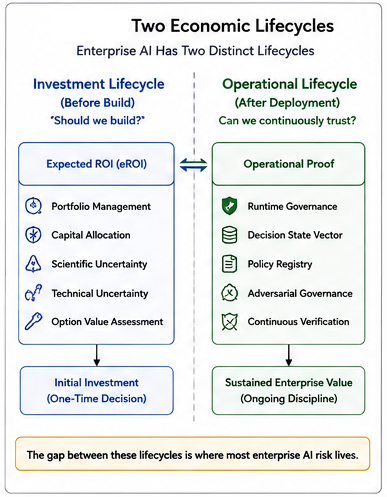
AI Has Two Different Economic Lifecycles
Most organizations treat AI as if there is a single economic decision, the build decision. There are actually two, and they require completely different disciplines.
The Investment Decision (before build): Should we invest capital in this AI initiative? Expected ROI is the right tool. It surfaces scientific uncertainty, separates option value from direct product value, and structures the portfolio across archetypes: big bets, quick wins, and strategic bets.
The Operational Decision (after deployment): Can we continuously prove this system is functioning within its governance constraints, remaining reliable as data shifts, and creating business value without accumulating unhedged liability? Expected ROI has nothing to say about this.
The gap between these two decisions is where most enterprise AI risk actually lives.
A project with excellent eROI can become operationally catastrophic. A system that passes every pre-deployment check can silently drift into noncompliance. A model that performs well on production data at launch can degrade as retrieval indices re-embed, customer distributions shift, and implicit assumptions about the world stop holding.
Expected ROI calculates the upside of building an AI system. It does not protect against the downside of running one.
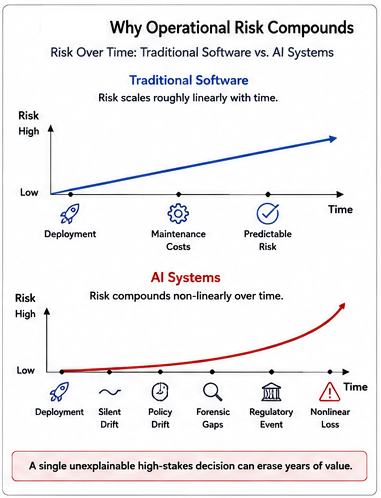
In traditional software, operational risk scales predictably with maintenance costs, roughly linear, reasonably foreseeable. In probabilistic AI, operational risk compounds non-linearly. A single unexplainable high-stakes decision, a loan denial, a medical recommendation, a fraud clearance, can trigger a regulatory examination that wipes out years of accumulated gross margin. The economics do not stop at deployment. They compound throughout the system's lifecycle.
| Phase | Before Deployment | After Deployment |
|---|---|---|
| Economic Discipline | Investment Economics | Operating & Risk Economics |
| Primary Question | Should we build this initiative? | Can we continuously trust and defend this system? |
| Core Frameworks | Portfolio Management & Expected ROI (eROI) | Operational Proof & Forensic Traceability (DSV) |
| Primary Risks | Scientific & Technical Uncertainty | Silent Drift & Accountability Debt |
The PM's AI Business Case Evaluation Matrix: Expected ROI vs. Operational Proof
When reviewing AI project proposals in portfolio planning or executive budget reviews, use this matrix to balance pre-build upside against post-launch operational defense:
| Investment Evaluation Dimension | What the Traditional eROI Model Calculates | What Gets Missed in Production | What the PM Must Audit Before Capital Allocation |
|---|---|---|---|
| Value Upside | Gross labor saved if the model operates perfectly. | Cost of human double-checking and review chore overhead. | Net Workflow Value: Calculate actual associate review time saved, net of verification. |
| Failure Probability | Flat percentage discount on likelihood of launch success. | Catastrophic, non-linear tail risk from confident hallucinations. | Worst-Case Failure Liability: Calculate remediation cost if the model executes an unauthorized state change. |
| Compliance & Safety | One-time integration and legal review budget line item. | Accumulating Accountability Debt from unrecorded autonomous actions. | Forensic Readiness: Verify that every consequential decision logs an immutable Decision State Vector. |
| Model & Data Drift | Assumes production input distribution matches training data. | Silent semantic drift when external documents or vendor weights change. | Regression Test Harness: Automated re-verification whenever prompts or model checkpoints update. |
| Kill & Rollback Path | Assumes project completes or is cancelled before launch. | System gets deployed, accumulates customer dependencies, and cannot be shut down. | Circuit Breaker SLA: Can an operator revert autonomous execution to human triage in $< 60$ seconds? |
What Does the Investment Decision Miss?
The eROI framework identifies compliance, safety, and fairness requirements as line-items that increase "Integration & Productization Effort", costs in the denominator that reduce the investment attractiveness of a project.
This is technically accurate and practically dangerous.
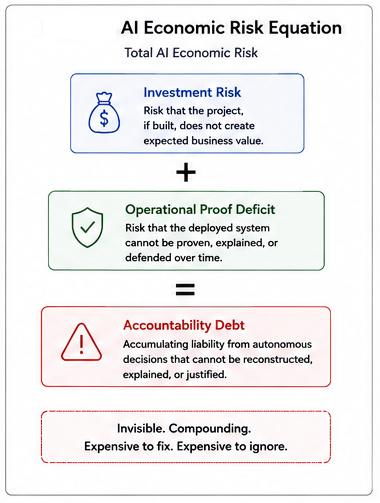
In high-consequence AI, governance is not a deployment cost. It is an ongoing control plane constraint. A system that passes its initial compliance review and then operates without executable governance controls accumulates Accountability Debt, the liability created by autonomous decisions that cannot later be reconstructed, explained, or justified.
Accountability Debt is the operational counterpart to Assumption Debt. Both accumulate silently. Both are invisible until an incident or regulatory examination forces them into the open. Both cost far more to resolve than to prevent.
The eROI framework captures the cost of building governance at deployment. It does not capture the cost of enforcing governance in production, because that cost is not a one-time investment. It is a continuous infrastructure requirement.
The Missing Infrastructure Layer
Many current AI investment frameworks focus primarily on project selection. They assume business value flows naturally from implementation.
Enterprise experience suggests otherwise. The missing layer, between deployment and sustained value, is continuous operational proof: the verifiable, ongoing demonstration that a deployed system is behaving within its governance constraints, producing decisions that can be forensically reconstructed, and remaining within authorized autonomy boundaries as data shifts, retrieval indices re-embed, and the world changes around the model.
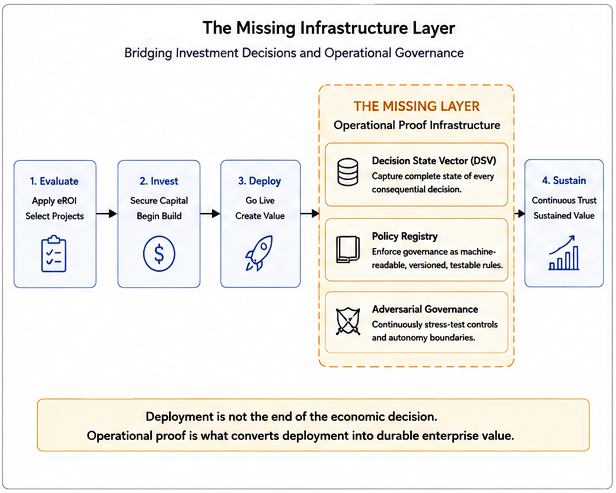
Operational proof is not a monitoring dashboard. Monitoring tells you whether metrics are drifting. Operational proof tells you whether the specific decision the system made at a specific moment was within the rules that governed it at that moment, a distinction that matters when a regulator asks not "is your model performing well?" but "why did this customer receive this decision?"
The Technical Dependency Graph Problem
The reason project selection frameworks and model benchmarks fail as operational standards is that they treat AI as a standalone model.
In an enterprise environment, an AI decision is the output of a multi-layered technical dependency graph:
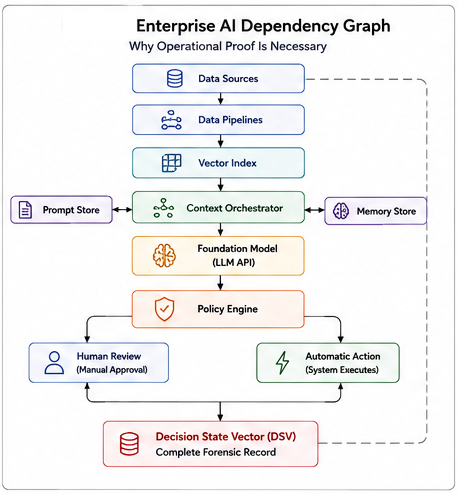
When a production system fails, the root cause is rarely that the foundation model suddenly lost intelligence. It is a dependency interaction failure: * A vector index re-embedded chunks under a modified schema. * A third-party model provider updated API weights without notice. * Context truncation silently dropped a governance rule from the prompt. * A human review queue timeout triggered an unmonitored fallback path.
Because liability lives in the interaction of these technical dependencies, an operational standard cannot evaluate a model in isolation. It must be a systemic forensic standard, capturing the complete execution graph at the exact moment a decision is made.
Expected ROI calculates the upside of building an AI system. Operational proof prevents the downside of running one. They are not competing disciplines. They are sequential ones.
From Portfolio Management to Fiduciary Defensibility
The deeper implication extends beyond any single organization.
The AI industry has spent three years optimizing intelligence. That turns out to be the easier problem.
Most AI frameworks today stop at project selection. They assume business value flows naturally from deployment. But the industry is not yet good at what comes next: continuously proving that deployed AI systems remain controlled, auditable, and worthy of the trust the business has extended to them.
Other industries have solved analogous problems:
Financial markets developed credit ratings and audited financial statements, not because regulators demanded a specific format, but because capital markets cannot price risk they cannot see.
Manufacturing developed ISO quality certifications, not because factories needed more paperwork, but because supply chains cannot trust components whose quality cannot be independently verified.
Cloud computing developed service-level agreements, not because customers needed contractual assurance of uptime, but because enterprises cannot build on infrastructure whose reliability has no common language.
Enterprise AI will require an equivalent layer: verifiable operational proof. Not because organizations need another monitoring metric, but because executives, regulators, and counterparties cannot price the risk of an AI system they cannot audit.
What an Industry Norm Looks Like
An industry norm for operational proof is not a rigid 500-page manual or a single test score. It is a risk-tiered evidentiary standard structured across three technical pillars:
| Evidentiary Pillar | Technical Implementation Mechanism | Enterprise Risk Function |
|---|---|---|
| 1. Standardized Forensic Record | Immutable Decision State Vectors (DSVs) logging checkpoint hash, prompt digest, chunk IDs, and confidence. | Provides cryptographic evidence required to reconstruct incidents and isolate component fault within 5 minutes. |
| 2. Executable Policy Interface | Machine-readable Policy Registries compiled and verified in CI/CD pipelines. | Ensures organizational compliance obligations are enforced as deterministic runtime boundaries rather than prose guidelines. |
| 3. Risk-Tiered Verification | Autonomy control tiers (Tier 1 Assist to Tier 4 Autonomous) scaling proof depth to consequence. | Prevents governance drag on low-risk tools while enforcing adversarial red-teaming on high-consequence balance-sheet decisions. |
Evolution and Adaptation
Like GAAP in accounting or building codes in civil engineering, an industry norm for AI is both dynamic and context-aware:
- It evolves over time: Just as GAAP evolved from 1930s industrial accounting to modern SaaS revenue recognition and digital assets, an AI operational norm evolves as technology shifts, from text retrieval and RAG to multi-modal agents and autonomous tool-use chains.
- It adapts to the project: Building codes scale from garden sheds to skyscrapers without changing structural principles. An operational norm scales proof requirements based on consequence, giving high-stakes systems strict fallback gates while leaving low-risk applications lightweight.
That standard does not yet exist as an industry norm. Organizations that build the infrastructure now will hold a structural advantage when it becomes one.
Four Questions. One Progression.
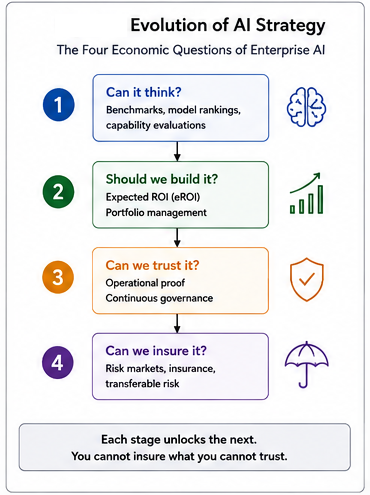
The economic history of enterprise AI can be organized around four questions, each of which represents a maturity stage the industry has addressed, or has not yet addressed.
Can it think? Benchmarks, model rankings, and capability evaluations answer this. The AI industry has largely solved it.
Should we build it? Expected ROI answers this. The industry is beginning to answer it well.
Can we trust it? Operational proof, continuous, verifiable demonstration that deployed systems behave within their governance constraints, answers this. The industry has barely started.
Can we insure it? As AI liability matures, financial markets and underwriters will eventually ask this fourth question. Transferable risk instruments require verifiable operational proof.
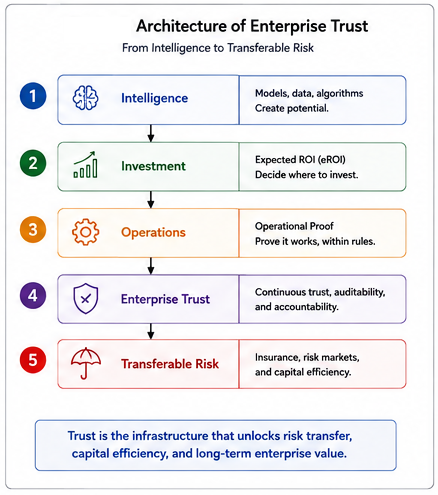
Each stage unlocks the next. Capital markets cannot price insurance on systems whose trust cannot be verified. You cannot verify trust without operational proof. You cannot invest in operational proof without first selecting the right systems to operate.
Expected ROI moves the industry from the first question to the second. That is genuine progress.
The third question is where enterprise AI strategy must go next.
The Adversarial Stress-Test: Five Critical Inquiries
1. What is the strongest argument against this approach?
Demanding continuous operational proof, immutable forensic ledgers, and formal Policy Registries imposes a heavy upfront engineering tax that cripples early-stage product momentum and distorts the cost-side of the eROI calculation, putting disciplined enterprises at a disadvantage against agile competitors who prioritize rapid feature shipping.
The Practical Resolution: Stage operational proof requirements along an autonomy gradient. Early discovery pilots and internal assistive copilots operate with lightweight, non-blocking telemetry (basic structured logging and exception captures) that costs virtually nothing to implement. Full cryptographic Decision State Vectors, immutable ledgers, and adversarial stress suites are mandated only when systems transition to autonomous execution (Tier 3 and Tier 4) where unhedged liability could exceed initial project capital.
2. Under what circumstances would this fail?
Operational proof architectures fail when the volume of autonomous transactions creates an unmanageable telemetry burden that overwhelms storage budgets, or when human exception queues suffer backpressure so severe that reviewers rubber-stamp flagged transactions without inspecting the underlying Decision State Vectors.
The Practical Resolution: Implement two-tier tiered storage and cognitive exception budgets. Stream high-velocity decision traces into ephemeral 30-day queryable caches while archiving cryptographic hash roots and anomalous traces into permanent immutable cold storage, slashing data infrastructure costs by 80%. When exception volumes exceed modeled human review capacity, automated circuit breakers dynamically shed traffic to conservative fallback rules to prevent reviewer exhaustion.
3. What would a skeptical customer, client, or colleague object to?
Enterprise CFOs and business unit sponsors will object that eROI models already incorporate operational failure as a probability discount inside "Likelihood of Success," arguing that creating a separate "Operational Proof" governance category is redundant academic bookkeeping.
The Practical Resolution: Show finance leadership that traditional probability discounts assume linear failure modes, whereas autonomous operational failures scale non-linearly. A 10% risk discount on project value does not protect the enterprise balance sheet against an uncapped class-action lawsuit or regulatory consent decree triggered by an unexplainable autonomous decision. Operational proof converts unquantifiable catastrophic tail risk into predictable, boundable opex.
4. Which alternative deserves more consideration?
Continuous statistical anomaly detection and commercial liability insurance: deploying systems based purely on eROI calculations, while relying on automated statistical process control to detect macroscopic metric drifts and third-party insurance policies to absorb individual failure liabilities.
The Practical Resolution: Treat insurance and anomaly detection as the downstream beneficiaries of operational proof rather than alternatives. Insurers cannot write affordable affirmative policies for autonomous AI without verifiable telemetry (such as DSVs and policy version logs) to prove root cause and assign subrogation. Operational proof provides the exact forensic data infrastructure required to make algorithmic risk insurable in the first place.
5. What am I assuming that may not be true?
This analysis assumes that enterprise leadership and board audit committees possess the technical discipline to prioritize long-term downside containment over short-term quarterly feature delivery, even during competitive market bubbles where unconstrained competitors claim massive initial productivity gains.
The Practical Resolution: Compile Accountability Debt into a visible, dollar-denominated risk balance sheet presented at board audit reviews. By quantifying unhedged exposure (transactions executed without immutable DSVs multiplied by maximum regulatory fines or dispute liability), governance leaders transform abstract compliance concerns into board-level financial risk metrics that counterbalance short-term feature velocity pressure.
One-Line Synthesis
Sustained enterprise AI value requires coupling upfront capital allocation with continuous operational proof, ensuring that deployed autonomy remains forensically verifiable, policy-constrained, and economically insurable.
Frequently Asked Questions
What is the eROI framework for AI investment?
Expected ROI (eROI) is an AI project evaluation framework that decomposes each investment bet into three components rated separately: Value if Successful (what the product would be worth if it worked), Likelihood of Success (how likely it is to work, including scientific and technical uncertainty), and Investment Required (the total cost to build, integrate, and productize). The framework helps organizations allocate AI investment capital across a portfolio of bets rather than selecting a single top-ranked project.
Why is expected ROI insufficient for enterprise AI?
Expected ROI answers a portfolio management question: which AI projects deserve capital before they are built? Enterprise AI introduces a second, entirely different class of questions after deployment: whether the system remains reliable as data shifts, whether failures can be forensically reconstructed, whether governance policies actually enforce themselves in production, and whether accumulating autonomous decisions are creating unhedged liability. Expected ROI calculates the upside of building an AI system. It does not protect against the downside of running one.
What is the difference between AI investment risk and AI operational risk?
Investment risk is the risk that an AI project, if built, will not create the expected business value. Operational risk is the risk that an AI system, once deployed and generating value, will fail silently, drift without detection, or make autonomous decisions that create legal, regulatory, or reputational liability. Investment risk is resolved by good portfolio management at project selection. Operational risk is ongoing and compounds throughout the system's lifecycle. Most AI frameworks address the first. The second is largely unaddressed.
What is operational proof in AI systems?
Operational proof is the continuous, verifiable demonstration that a deployed AI system is behaving within its governance constraints, producing decisions that can be forensically reconstructed, and remaining within the autonomy boundaries established at deployment. It requires three infrastructure components: a Decision State Vector that captures the complete hidden state of every consequential decision, a Policy Registry that enforces governance obligations as machine-readable, versioned, testable rules, and an adversarial governance function that continuously stress-tests whether those controls actually hold under production conditions.
What is Accountability Debt in AI?
Accountability Debt is the accumulating liability created when an AI system makes autonomous decisions that cannot be explained, reconstructed, or demonstrated to be within governance constraints. Just as Assumption Debt accumulates when implicit beliefs about distribution stability go untested, Accountability Debt accumulates when systems operate without forensic infrastructure. Both forms of debt are invisible until an incident or regulatory examination forces them into the open, at which point the cost of resolving them is far higher than the cost of preventing them.
How does the Decision State Vector relate to AI ROI?
A Decision State Vector (DSV) captures the complete hidden state at the moment of every consequential AI decision: the model version, retrieved context, policy version, confidence score, and action taken. Without a DSV, a high-value AI system that fails cannot be forensically reconstructed, which means the incident cannot be resolved, regulators cannot be satisfied, and the business cannot distinguish between a model failure, a retrieval failure, and a policy failure. The DSV is the forensic infrastructure that protects the business value that eROI helped unlock.
Subscribe to the Architecture of Proof Dispatch
Rigorous, decision-forcing systems engineering and AI governance monographs for technical leaders. Delivered periodically, zero spam.