Policy as Code: The Infrastructure Layer Between AI Governance Documents and Enforcement
Every AI governance program eventually arrives at the same uncomfortable moment.
An incident occurs. The investigation begins. Somewhere in the stack of post-incident evidence, someone pulls up the governance policy document. It says, clearly, in writing: decisions with confidence below the threshold require human review before execution.
The system did not route to human review. The decision was executed autonomously. The threshold was wrong in the code. Nobody caught it.
The policy existed. The enforcement did not. And the document, however well-written, had no way to make the system do what it said.
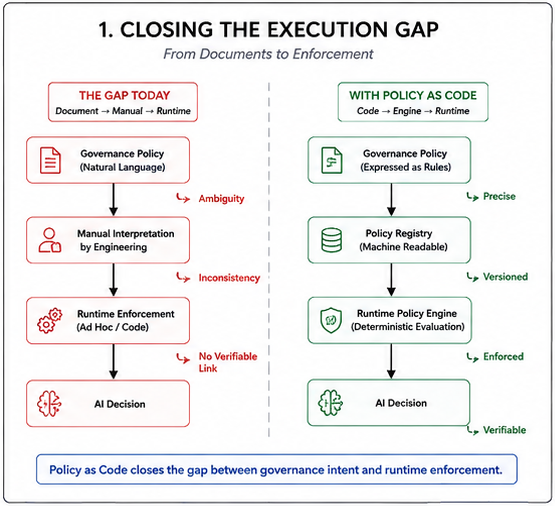
This is not a governance failure in the conventional sense. The policy was written. The intent was clear. The failure is something more specific: a governance policy that lives only in a document cannot enforce itself. And the gap between the document and the running system is not closed by process; it is closed by infrastructure.
Why Do Narrative Governance Policies Fail in Production?
The governance operating model describes three layers: policy, controls, and production operations. The operating model assumes that the translation from policy to controls happens reliably. In practice, it rarely does, not because teams are negligent, but because the translation is manual and invisible.
Consider what it takes to move a single governance rule from document to enforcement.
A governance team writes: "The system must escalate any inference decision where the model's confidence score falls below 0.70 for Tier 2 transactions."
For that sentence to enforce itself, an engineer must:
- Locate the confidence score in the inference response payload
- Decide which field name maps to "confidence" for each model provider in use
- Define what "Tier 2 transaction" means in terms of a runtime-evaluable condition
- Implement the escalation action: not just a log entry, but a durable routing event that reaches the review queue
- Ensure the threshold value (0.70) is stored in a way that can be changed without a code deployment
- Ensure the threshold value applied to each past decision is recorded alongside the decision, so it can be audited later
Steps 1 through 6 are all silent implementation decisions. None of them appear in the governance document. Any one of them can produce a gap between what the policy says and what the system does.
The execution gap is the distance between a governance obligation and the code that enforces it. Policy as Code does not eliminate this distance. It makes it visible, testable, and auditable.
Most organizations carry a large, unmeasured execution gap. They discover it the same way they discover assumption debt: during an incident, when someone asks "did the rule fire?" and the answer is "we're not sure."
What Are the Core Architectural Properties of Policy as Code?
Policy as Code is not a product category. It is a set of properties that governance rules must have to be operationally enforceable.
Property 1: Machine-Readable. A machine-readable policy is expressed in a structured format that a system can evaluate at runtime without human interpretation. It contains precisely defined conditions, actions, thresholds, and scopes. It does not contain judgment calls, contextual qualifiers, or language that requires a person to decide what it means in a specific situation.
This property has a hard boundary. Some governance obligations translate cleanly into deterministic constraints:
- Confidence score below 0.70 → escalate
- Transaction tier 2 → require human approval for loans above $50,000
- Prohibited input category detected → reject and log
Others do not:
- Exercise reasonable care
- Assess proportionality to the risk
- Evaluate for discriminatory impact in unusual customer circumstances
Policy as Code handles the first category. The second category still requires human judgment, and the governance document that defines that judgment remains essential. The Policy Registry does not replace narrative governance documents. It encodes the portion of their intent that can be expressed as executable logic, and explicitly defers the rest to human review. A rule entry that routes ambiguous cases to a designated reviewer is itself a form of Policy as Code: it uses the system to enforce the obligation to consult a human, rather than pretending the system can resolve the judgment.
Property 2: Versioned. A versioned policy has a stable, unique identifier tied to its exact content at a specific point in time. When the policy changes, a new version is created; the old version is never modified in place. Every production decision can be linked to the exact policy version that governed it. Forensic reconstruction is possible because the policy that applied to a specific decision can be retrieved, not inferred.
Property 3: Testable. A testable policy has automated test cases that assert it fires correctly for defined inputs. Policy unit tests run before any rule change reaches production. If the test passes, the rule will behave as specified. If the test fails, the gap is caught before it becomes a compliance gap.
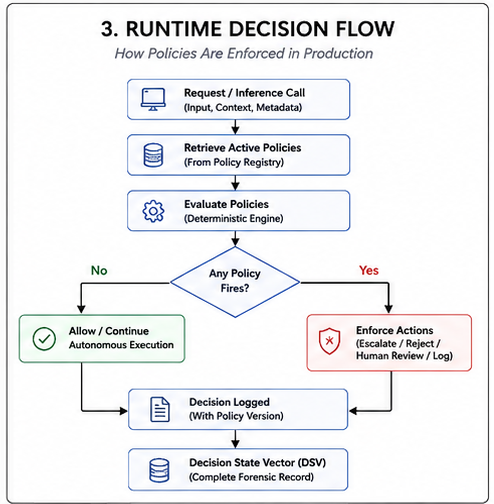
Property 4: Auditable. An auditable policy produces evidence of its own execution. Every time a rule evaluates an input (whether it fires or does not fire), the evaluation event is logged with the policy version, the input hash, the evaluation result, and the action taken. The audit trail is a first-class output of policy execution, not an afterthought.
A natural-language policy in a governance document has none of these four properties. It cannot evaluate inputs, it has no stable version identifier, it cannot be unit-tested, and it produces no execution log.
A policy that cannot be tested cannot be trusted. A policy that cannot be versioned cannot be reconstructed. A policy that does not produce an execution log cannot be audited. These are not aspirational standards; they are the minimum requirements for a governance rule that can be expressed deterministically to be operationally real.
How Does a Policy Registry Function as an Authoritative Source of Truth?
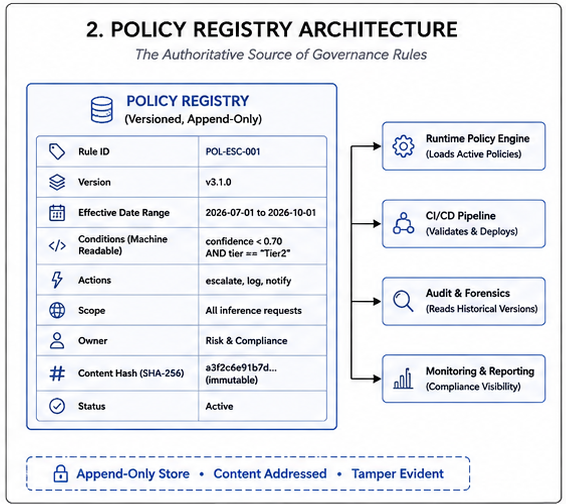
The infrastructure artifact that gives Policy as Code its operational foundation is the Policy Registry: a versioned, append-only store of all governance rules active in the system.
The Registry is not a configuration file. Configuration files are mutable and often lack audit trails. The Registry is not a governance document repository. Document repositories version narrative text, not executable constraints. The Registry is a purpose-built governance infrastructure component with three mandatory properties:
Append-only. Rules are never modified in place. A rule change creates a new version entry with a new effective date. The old version remains permanently readable. This makes it possible to retrieve the exact rule set active at any historical timestamp, which is what forensic reconstruction requires.
Content-addressed. Each Registry entry has a SHA-256 hash of its exact content. The hash is what gets written into the Decision State Vector's Policy Version field. If the rule content and the hash do not match, tampering is detectable. If the hash in a DSV record matches the Registry entry, the policy that governed that decision is precisely identified.
Schema-validated. Every rule entry must conform to a defined schema before it is accepted into the Registry. The schema enforces that required fields are present (condition, action, threshold, scope, owner, effective date) and rejects entries that cannot be automatically evaluated.
A minimal Policy Registry entry looks like this:
{
  "policy_id": "TIER2_CONFIDENCE_ESCALATION",
  "version": "v2.3.1",
  "effective_from": "2026-07-15T00:00:00Z",
  "effective_until": null,
  "owner": "ai-risk-governance@org.com",
  "scope": {
    "transaction_tier": 2,
    "model_types": ["classification", "scoring"]
  },
  "condition": {
    "field": "inference.confidence_score",
    "operator": "less_than",
    "threshold": 0.70
  },
  "action": {
    "type": "escalate",
    "target": "human_review_queue",
    "priority": "high",
    "timeout_seconds": 3600,
    "timeout_fallback": "tier_downgrade"
  },
  "content_hash": "sha256:a3f8c2d91e4b..."
}
Every field in this entry is evaluable at runtime. The system does not interpret intent: it evaluates conditions and executes actions. The owner field names accountability. The timeout_fallback field encodes what the system does when the human review queue does not respond in time: a field that governance documents almost never specify and production systems almost always handle incorrectly.
Who Authors the Registry Entry?
Machine-readable does not mean machine-generated. Governance teams define the obligation in natural language. Engineers (or governance tooling built on top of the Registry schema) translate the deterministic portion of that intent into an executable entry. Governance teams then validate the translation against the original obligation before the entry is admitted to the Registry.
This division matters for adoption. Compliance lawyers and risk officers are not expected to write JSON. They are expected to define what the rule must do and to confirm that the encoded version faithfully represents their intent. The Registry schema is the interface between those two functions: precise enough to be executable, readable enough to be reviewable by non-engineers.
The hardest part of building a Policy Registry is not the infrastructure. It is the translation step. Obligations like "the model must not discriminate on protected characteristics" or "decisions must be proportionate to the risk" cannot be directly encoded without first decomposing them into specific, measurable sub-conditions. That decomposition requires collaboration between governance, legal, and engineering, which is work that most organizations have never systematically done. The Registry forces the conversation. That is both its main friction and its main value.
The Runtime Cost of Policy Evaluation
Evaluating a policy set per inference is not free. At scale (many rules, high request volume), organizations will need to consider:
- Latency: Policy evaluation adds to inference latency. The standard mitigation is to evaluate only the rules whose scope matches the current request, indexed by transaction tier, model type, and jurisdiction at rule admission time.
- Caching: The active rule set for a given scope changes rarely. Caching the compiled rule set in memory (with cache invalidation on Registry writes), eliminating per-request Registry reads for the common case.
- Version synchronization: In distributed deployments, different nodes may be running different cached versions of the rule set during a policy update window. The Registry's
effective_fromtimestamp, combined with a short synchronization window, provides the consistency guarantee: decisions made during the window are flagged for audit rather than silently passing or failing against the wrong version.
These are engineering problems, not conceptual flaws in the architecture. They are the same class of problems that distributed configuration management solves, and the solutions are well-understood. The difference is that policy evaluation failures are compliance failures, not performance failures, which raises the stakes on getting the consistency model right.
How Do You Unit-Test Governance Rules Before Production Deployment?
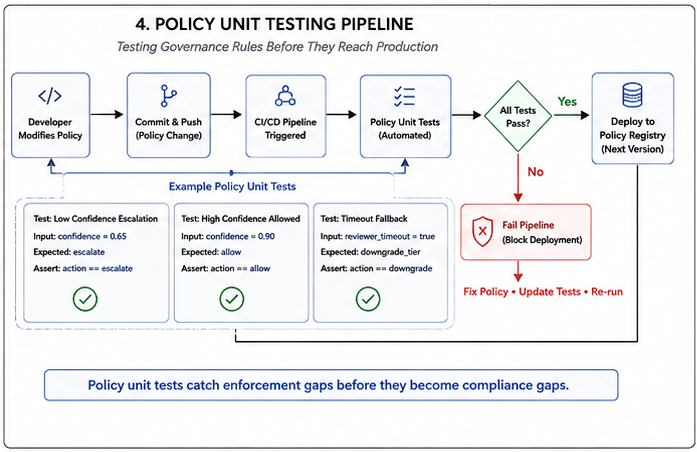
The highest-leverage practice in Policy as Code is running automated tests against governance rules before any change reaches production.
A policy unit test asserts that a rule fires correctly for a defined input. It runs in the same CI/CD pipeline that deploys application code. A rule change that breaks its unit tests is blocked from deployment the same way a code change that breaks application tests is blocked.
def test_tier2_confidence_escalation_fires_below_threshold():
    """Asserts the escalation rule fires for confidence = 0.65 on a Tier 2 transaction."""
    registry = PolicyRegistry.load_current()
    rule = registry.get("TIER2_CONFIDENCE_ESCALATION")

    decision_context = {
        "transaction_tier": 2,
        "inference": {
            "confidence_score": 0.65,
            "model_type": "scoring"
        }
    }

    result = rule.evaluate(decision_context)

    assert result.fired is True
    assert result.action.type == "escalate"
    assert result.action.target == "human_review_queue"
    assert result.policy_version == rule.version
    assert result.content_hash == rule.content_hash


def test_tier2_confidence_escalation_does_not_fire_above_threshold():
    """Asserts the rule does NOT fire for confidence = 0.85 on a Tier 2 transaction."""
    registry = PolicyRegistry.load_current()
    rule = registry.get("TIER2_CONFIDENCE_ESCALATION")

    decision_context = {
        "transaction_tier": 2,
        "inference": {
            "confidence_score": 0.85,
            "model_type": "scoring"
        }
    }

    result = rule.evaluate(decision_context)

    assert result.fired is False


def test_timeout_fallback_triggers_tier_downgrade():
    """Asserts that when escalation times out, the system downgrades tier rather than
    defaulting to autonomous execution: the exact behavior Adversarial Governance
    Scenario 1 is designed to expose."""
    registry = PolicyRegistry.load_current()
    rule = registry.get("TIER2_CONFIDENCE_ESCALATION")

    result = rule.simulate_timeout()

    assert result.fallback_action.type == "tier_downgrade"
    assert result.fallback_logged is True
The third test is the most important. It asserts the timeout fallback behavior. A policy that specifies "timeout_fallback": "tier_downgrade" but whose fallback implementation defaults to autonomous execution is a policy that exists on paper and fails in production. The unit test catches this before deployment, not during a regulatory examination.
How Does Policy as Code Anchor the Decision State Vector?
The Policy Registry closes a forensic gap that the Decision State Vector's R_policy field creates.
The DSV's policy version field records which policy governed a specific decision. But that recording is only forensically meaningful if the recorded version corresponds to a retrievable, immutable artifact. If policies are stored in documents, the "version" is typically a date or a document name, neither of which guarantees that the content at that version was the same at the time of the decision as it is when the investigator reads it.
With a Policy Registry:
- The
R_policyfield stores the content hash of the active Registry entry at decision time. - The hash uniquely identifies the exact rule content that governed the decision.
- The Registry's append-only architecture guarantees that entry has not changed since the decision was made.
- Forensic reconstruction can retrieve the exact rule, replay the evaluation against the recorded inputs, and verify that the system's behavior was consistent with the policy version logged.
Without a Policy Registry, the DSV's policy version field is a label. With a Policy Registry, it is evidence.
The Decision State Vector tells you what the system decided. The Policy Registry tells you what the system was permitted to decide. Together, they answer the compliance question that regulators and auditors actually ask: did the system's behavior, at this specific moment, fall within the governance constraints that were in effect at that time?
How Do Governance Policies Move from Intent to Enforcement?
Policy as Code does not eliminate the human judgment that goes into writing governance rules. It structures the pipeline that moves a rule from intent to enforcement to retirement.
Draft. A new rule is authored in the Policy Registry schema by the governance function that owns the obligation. Schema validation catches missing fields before the rule advances. The owner field is mandatory: a rule with no owner cannot be admitted to the Registry.
Review and Validate. The drafted rule is reviewed by the functions responsible for implementation (engineering), compliance (legal/risk), and operational impact (product). Policy unit tests are written during this stage, not after. A rule that cannot be unit-tested is not ready to deploy.
Deploy. The new version is committed to the Registry with an effective date. The old version's effective_until field is set to the transition timestamp. Deployment does not require a code change: the policy enforcement layer reads from the Registry at runtime.
Monitor. Every rule evaluation in production generates an event. The monitoring layer tracks: rule fire rate, false-positive and false-negative rates against a holdout sample, action completion rate (escalation fired but not acted upon), and timeout fallback frequency. Anomalies trigger alerts to the rule owner.
Retire. When a rule is no longer required, its effective_until is set and the rule is marked retired. It is never deleted. The complete history of every rule ever active in the system remains readable for forensic and audit purposes.
What Does Policy as Code Change During a Regulatory Audit?
The governance operating model already defines the structure. Policy as Code changes the nature of the controls layer.
Without it, the controls layer is implemented by engineers interpreting governance documents and writing enforcement logic that has no direct, testable connection to the policy text. The gap is invisible until an incident makes it visible.
With it, the controls layer is the Policy Registry, and the enforcement layer is a runtime evaluator that reads from it. The governance document becomes the source of requirements for the Registry entry, not the enforcement mechanism itself.
This changes what regulators can examine. Instead of asking "do you have a policy that covers this?" and receiving a document, they can ask "what was the policy version active for this decision?" and receive a content-addressed, immutable, machine-readable rule that can be evaluated against the decision's recorded inputs.
SR 11-7 requires ongoing model governance with attributable outputs. EU AI Act Article 9 requires documented risk management systems with continuous monitoring obligations. FDA SaMD guidance requires post-market surveillance capable of detecting performance degradation. None of these frameworks use the phrase "Policy as Code." All of them describe a standard of demonstrated control that document-based governance cannot satisfy, and that a Policy Registry, combined with the Decision State Vector, can.
How Does Policy as Code Mature Across the Enterprise?
Few organizations will build a fully featured Policy Registry in a single initiative. The practice develops incrementally, and each stage delivers value before the next one is reached.
| Stage | Capability |
|---|---|
| Stage 1: Documents | Governance policies exist in narrative documents, manually interpreted at enforcement points |
| Stage 2: Checklists | Documents are supplemented with implementation checklists that map policy intent to specific system behaviors |
| Stage 3: Versioned Rules | Key deterministic obligations are expressed as versioned, machine-readable entries with stable identifiers |
| Stage 4: Policy Registry | A centralized, append-only Registry serves as the authoritative source for all machine-readable rules |
| Stage 5: Automated Tests | Policy unit tests run in CI/CD pipelines; rule changes that fail tests are blocked from production |
| Stage 6: Runtime Enforcement with Forensic Replay | The Registry drives runtime evaluation; every decision is linked to its governing policy version in the Decision State Vector |
Most organizations in regulated industries are at Stage 1 or Stage 2. The five-field Registry schema and unit tests in this post describe Stages 4 and 5. Organizations do not need to skip to Stage 6 for the framework to be useful: each stage meaningfully narrows the execution gap.
The PM's Policy as Code Translation & Deployment Matrix: Sprint Review Governance Checklist
When product managers, compliance officers, and engineering leads sit down in sprint planning to translate legal or risk policies into production features, use this matrix to define executable constraints and Go/No-Go release gates:
| Narrative Policy Obligation | Machine-Readable Runtime Condition | Automated Execution & Routing Action | Mandatory CI/CD Policy Unit Test | PM Go/No-Go Release Gate |
|---|---|---|---|---|
| "High-risk loans must be reviewed by senior underwriters." | tier == 2 AND loan_amount > 50000 AND confidence < 0.75 |
Route payload to Senior Underwriting Queue with 4h SLA timer; halt automated approval. | Submit synthetic transaction with confidence = 0.72; assert escalation fired and state locked. | NO-GO if loans $> \$50k$ can approve without cryptographic reviewer signature. |
| "System must not use prohibited demographic features." | Input schema excludes zip_code, age, gender, marital_status from model feature vector. |
Gateway strips unauthorized fields; rejects request with HTTP 422 if prohibited key present. | Inject malformed payload containing prohibited keys; assert deterministic rejection before model. | NO-GO if feature pipeline accepts unvalidated JSON payloads without schema validation. |
| "Transactions from sanctioned jurisdictions must be blocked." | Origin IP or beneficiary country code matches OFAC/EU sanction list hash in memory. | Immediate P1 blocking event; zero model evaluation; log audit trace with content hash. | Test against 20 known sanction codes and 20 clean codes; assert 100% true-positive blocking. | NO-GO if sanctions filter allows asynchronous bypass during high network latency. |
| "Adverse credit decisions must provide actionable recourse." | Counterfactual optimizer computes minimal feasible delta on controllable variables. | Emit top 3 actionable interventions (e.g., "reduce card balance by $800") in adverse action notice. | Assert counterfactual changes only propose mutable features (reject if age/tenure proposed). | NO-GO if denial notice outputs raw SHAP scores instead of actionable borrower steps. |
| "If human reviewer queue times out, avoid unreviewed execution." | Review queue wait time exceeds timeout_seconds: 3600 without operator claim. |
Automated tier downgrade; freeze transaction state; emit P2 alert to duty manager. | Simulate queue timeout event; assert system downgrades rather than auto-approving. | NO-GO if review queue timeouts default to automated execution. |
How Do Decision Vectors, Adversarial Testing, and Policy as Code Connect?
This post is the third in a sequence that addresses the same governance problem from three different angles.
The Decision State Vector (forensic-postmortem) captures what the system decided: the complete hidden state that produced a specific output at a specific moment. It answers the question: what happened?
Adversarial Governance tests whether the governance controls that were supposed to constrain the system actually hold under deliberate pressure. It answers the question: do the controls actually work?
Policy as Code defines, in machine-readable and testable form, what the system was permitted to decide. It answers the question: what should have happened?
Together, these three concepts form the evidentiary architecture for consequential AI:
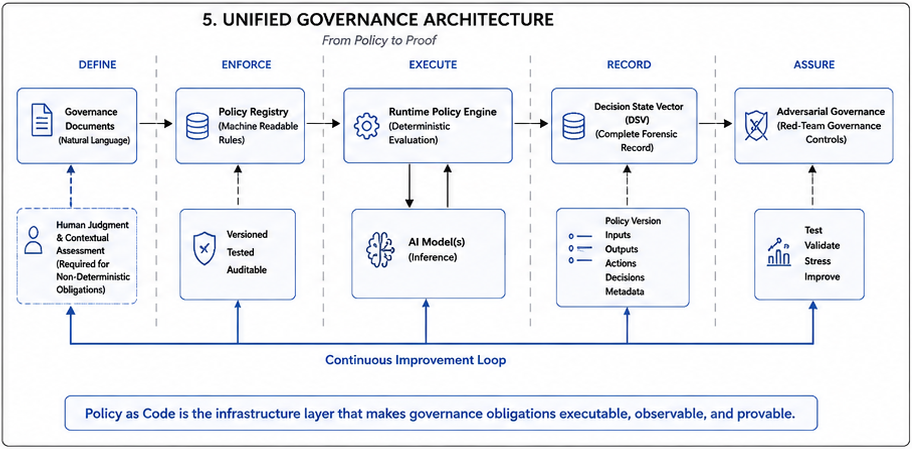
None of the three depends on speculative technology. Each relies on established software engineering practices (version control, immutable artifacts, schema validation, automated testing, and runtime policy evaluation) applied to the governance layer that most AI systems currently lack.
The Adversarial Stress-Test: Five Critical Inquiries
1. What is the strongest argument against this approach?
Translating nuanced narrative governance policies into deterministic code oversimplifies complex legal and ethical standards into rigid heuristics. The hardest governance challenges (such as "reasonable care," "proportionality," or "non-discriminatory impact") cannot be compiled into boolean syntax without stripping out the contextual judgment that legal compliance demands, creating a false sense of mathematical certainty.
The Practical Resolution: Establish a hybrid enforcement boundary. Encode deterministic statutory constraints, licensing eligibility rules, and quantitative exposure ceilings directly into machine-readable Policy Registry entries. For ambiguous legal standards requiring subjective appraisal, write policy rules whose explicit deterministic action is routing the payload to human legal counsel with a mandatory structured review template.
2. Under what circumstances would this fail?
This architecture fails when policy evaluation latency breaches inference SLAs in high-throughput streaming environments. If an enterprise accumulates hundreds of complex, overlapping policy rules with recursive dependencies or remote data lookups, evaluating the full policy suite for every transaction will introduce timeout cascades, forcing systems to fail-open or bypass evaluation entirely during traffic spikes.
The Practical Resolution: Compile active policies into in-memory Abstract Syntax Trees (ASTs) indexed by transaction tier, jurisdiction, and model type. Execute AST evaluations in local memory in under 5 milliseconds at the API gateway, eliminating remote registry queries during hot-path inference.
3. What would a skeptical customer, client, or colleague object to?
A skeptical legal or compliance officer will object that committing machine-readable policies to an immutable, content-addressed registry creates an unforgiving audit paper trail. If a minor technical bug in an encoded threshold causes technical non-compliance across millions of decisions where the underlying model behavior was harmless, the registry provides definitive, irrefutable evidence of systematic policy violation during regulatory discovery.
The Practical Resolution: Implement policy dry-run shadow modes and progressive canary deployments. Run new or modified policy versions in shadow mode against historical and live traffic for 14 days, verifying statistical compliance and identifying boundary errors prior to binding production promotion.
4. Which alternative deserves more consideration?
LLM-as-a-Judge runtime guardrails with natural language policy compilation. Rather than maintaining custom JSON schemas and deterministic evaluation engines, feed the natural language governance document directly into an isolated, fine-tuned alignment model that evaluates live inputs and model outputs contextually, handling edge cases and qualitative guidelines that resist boolean encoding.
The Practical Resolution: Restrict LLM-as-a-Judge guardrails to semantic moderation and qualitative brand-safety evaluations. In regulated environments involving statutory lending rules, sanctions lists, or capital limits, regulators mandate deterministic, auditable rules that produce identical outputs for identical inputs, which stochastic LLM judges cannot legally guarantee.
5. What am I assuming that may not be true?
This architecture assumes that governance and compliance officers have the technical literacy and organizational appetite to co-author, review, and validate machine-readable rule definitions alongside software engineers. In reality, legal and risk teams frequently resist structured schemas, preferring ambiguous narrative prose that preserves defensive legal flexibility during investigations.
The Practical Resolution: Build visual policy-authoring DSLs and bidirectional translation interfaces. Allow compliance personnel to configure policies via intuitive UI forms, dropdown matrices, and plain-English conditionals that automatically compile into schema-validated, content-hashed JSON definitions behind the scenes.
One-Line Synthesis
Policy as Code transforms static governance obligations into versioned, testable runtime constraints that actively prevent compliance violations at machine speed.
Frequently Asked Questions
What is Policy as Code in AI governance?
Policy as Code is the discipline of expressing deterministic governance rules as machine-readable, versioned, executable constraints. A policy expressed as code can be tested, deployed, monitored, and audited with the same rigor applied to software. Policy as Code does not replace narrative governance documents: it encodes the subset of governance obligations that can be expressed as precise conditions and actions, while human judgment remains essential for obligations requiring contextual assessment.
Why can't natural-language governance policies enforce themselves?
Natural-language policies require a human interpreter at every enforcement point. When a policy says 'high-risk decisions must be reviewed before execution,' the system does not know what high-risk means, what reviewed means, or what before execution means in the context of a specific API call at 2:47 AM. Machine-readable policies encode those definitions precisely (as thresholds, conditions, action types, and timing constraints), allowing the system to evaluate them without human interpretation at runtime.
How does Policy as Code relate to the Decision State Vector?
The Decision State Vector (DSV) includes a Policy Version field: the exact version of governance rules active at the moment of a specific decision. This field is only forensically meaningful if policies are versioned artifacts with stable identifiers. A natural-language document stored in a shared drive has no stable version identifier that can be reliably attached to a production decision. A Policy Registry entry has a content-addressed hash that uniquely identifies the exact rule set that governed a specific inference call, making forensic reconstruction of compliance possible.
What is a Policy Registry?
A Policy Registry is a versioned, append-only store of all machine-readable governance rules active in a system. Each entry has a stable identifier, an effective date range, a schema-validated rule definition, the owner function responsible for the rule, and a content hash that makes tampering detectable. The Registry is the authoritative source of truth for which rules were active at any moment: not a governance document, configuration file, or developer memory of what was deployed.
What is a policy unit test for AI governance?
A policy unit test is a test case that asserts a governance rule fires correctly for a defined input. For a rule that says 'escalate any inference where confidence falls below 0.7,' the unit test submits a synthetic decision with confidence 0.65 and asserts that the escalation action is triggered, logged, and correctly attributed to the current policy version. Policy unit tests run in CI/CD pipelines before any rule change reaches production, catching enforcement gaps before they become compliance gaps.
How is Policy as Code different from configuration management?
Configuration management controls system parameters: timeouts, retry counts, feature flags. Policy as Code controls governance obligations: what decisions the system is permitted to make autonomously, what inputs are prohibited, what conditions require human review, and what audit trail must be produced. The difference is accountability scope. A misconfigured timeout causes a performance issue. A misconfigured governance rule causes an undetected compliance violation. Policy as Code treats governance rules with the rigor that configuration management applies to infrastructure, but with the accountability requirements of regulatory compliance.
Subscribe to the Architecture of Proof Dispatch
Rigorous, decision-forcing systems engineering and AI governance monographs for technical leaders. Delivered periodically, zero spam.